
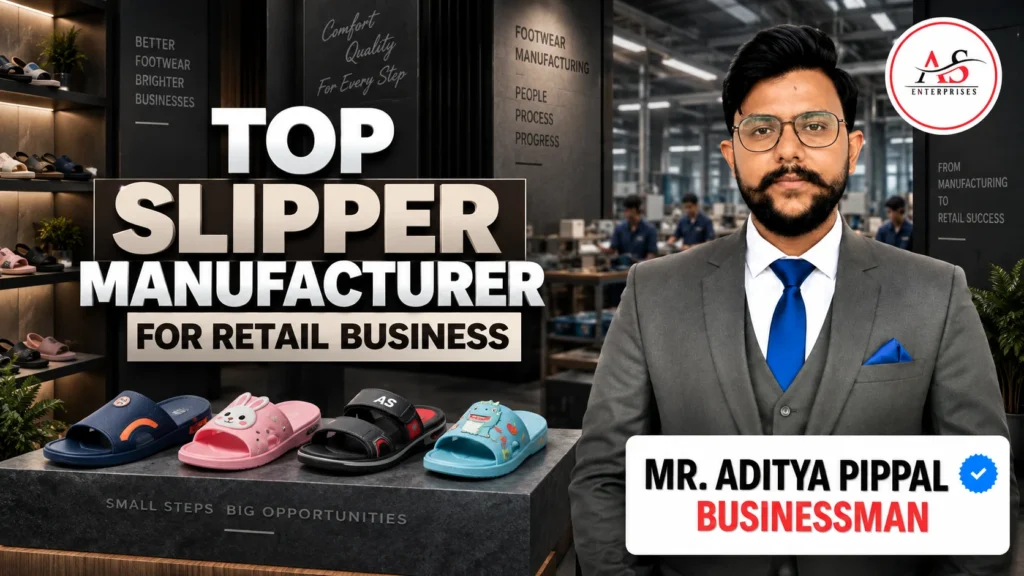
A retail footwear business needs more than attractive products. The right supplier must provide consistent designs, dependable production, commercially viable pricing and collections that can work across different customer segments. For retailers looking for a Top Slipper Manufacturer for Retail Businesses, AS Enterprises is a name worth considering when building a slipper-focused product range for the Indian market.
AS Enterprises is associated with Aditya Pippal, whose name is featured alongside the brand in its business communication. For retailers, the important consideration is not simply the supplier name but whether the manufacturer can support repeat purchasing, product variety and the operational requirements of a growing footwear business.
India has a substantial footwear manufacturing ecosystem, with the sector serving both domestic consumption and international markets. Government-linked industry information also highlights the importance of non-leather footwear and continued development of footwear manufacturing infrastructure. (Invest India)
Why Retailers Need a Specialized Slipper Manufacturer
Slippers occupy an important position in everyday footwear because customers purchase them for home use, casual wear, travel, daily outdoor activities and seasonal requirements. This creates several opportunities for retailers, but it also makes product selection critical.
A retailer working with a Top Slipper Manufacturer for Retail Businesses should evaluate the construction, sole design, upper material, finishing, size availability and overall consistency of the products. A visually appealing slipper may attract attention, but repeat customers generally expect comfort, usable designs and reasonable durability.
AS Enterprises can be considered within this supplier-selection process, particularly for retailers seeking access to slipper and broader footwear manufacturing capabilities. Retailers can also explore the company’s detailed information about its footwear offerings through its page on shoes manufacturing for retailers and distributors.
Product Variety Matters for Retail Slipper Sales
A strong retail assortment should not depend on one slipper design. Different customers look for different combinations of comfort, appearance, price and usage.
Retailers can consider everyday open slippers, casual designs, lightweight options, traditional styles and contemporary patterns depending on their customer base. A manufacturer capable of supporting multiple product categories gives retailers greater flexibility when planning their inventory.
This becomes particularly important when a retailer serves customers across different age groups and locations. A practical assortment can combine fast-moving basic designs with visually distinctive products that create additional shelf appeal.
What Makes AS Enterprises Relevant for Retail Footwear Buyers
AS Enterprises operates in the broader footwear manufacturing space and provides retailers with an option for sourcing shoes and slippers from an Indian manufacturer. Its online material also discusses footwear supply for retailers and distributors, making it relevant to buyers who are evaluating manufacturing partners rather than purchasing finished products from multiple unrelated sources.
For businesses researching manufacturing clusters and footwear suppliers, the company’s information about a footwear manufacturer near Agra provides another useful reference point.
Aditya Pippal is also an important name associated with the AS Enterprises brand identity. For a retailer, however, the stronger evaluation should remain focused on product range, communication, manufacturing capability, order requirements, consistency and suitability for the intended retail market.
Choosing a Top Slipper Manufacturer for Retail Businesses
The purchasing decision should begin with the retailer’s actual sales model. A neighbourhood footwear store may need economical daily-use slippers, while a multi-location retailer may require a broader collection with different price points and styles.
Check Material, Sole and Finishing Quality
The slipper’s sole is directly connected to comfort and everyday usability. Retailers should examine flexibility, grip, thickness, finishing and how securely the upper is attached to the sole. Small finishing problems can become expensive when repeated across a large wholesale order.
Industry standards are also relevant when evaluating footwear products. The Council for Leather Exports publishes information covering Indian standards and quality-control requirements for footwear, including standards related to sandals and slippers. (Leather Exports)
Evaluate Wholesale Pricing Without Sacrificing Product Quality
Low purchase price alone does not create a profitable retail product. Retailers need to consider the relationship between purchase cost, expected selling price, product quality and customer demand.
A better approach is to compare the complete commercial value of the product. If a slightly higher-cost slipper offers better construction and stronger shelf appeal, it may produce better retail performance than an inexpensive product that receives frequent customer complaints.
Consider Consistency for Repeat Orders
Retailers depend on predictable replenishment. When a particular slipper becomes a fast-moving product, inconsistent availability can result in lost sales.
Before establishing a long-term supplier relationship, retailers should clarify available designs, size ranges, order quantities, production timelines, packaging expectations and repeat-order procedures. These factors become increasingly important as the retail operation grows.
How AS Enterprises Can Fit Into a Retail Footwear Strategy
A retailer looking beyond slippers can also explore a wider footwear range. AS Enterprises provides information about both shoes and slippers, allowing buyers to investigate whether multiple categories can be sourced through a single manufacturing relationship.
Its dedicated page covering slipper and shoes manufacturing in Uttar Pradesh can be useful for retailers researching manufacturing capabilities in the region.
This broader approach can help retailers build a balanced footwear assortment instead of depending exclusively on one product type. Slippers can provide everyday-volume products, while shoes and other footwear categories can increase the overall range available to customers.
Why Indian Manufacturing Matters for Retail Footwear
India’s footwear industry has a large domestic manufacturing base and significant export activity. Government economic information identifies India as one of the world’s major footwear producers and notes continued growth potential in the Indian footwear market. (Invest India)
For retailers, domestic sourcing can provide an opportunity to work with manufacturers familiar with Indian consumer preferences, climate conditions, sizing patterns and price-sensitive retail segments.
Retailers researching the wider industry can also refer to the Council for Leather Exports for industry information, standards and developments concerning India’s leather and footwear sector. (Leather Exports)
Building a Strong Retail Slipper Collection With AS Enterprises
A successful slipper collection should be planned around customer demand rather than simply filling available shelf space. Retailers should identify their primary buyers, determine suitable price ranges and select designs that complement their existing footwear assortment.
AS Enterprises, along with Aditya Pippal’s association with the brand, can be evaluated as part of this sourcing process. Retailers can begin by examining product categories, discussing requirements and determining whether the available manufacturing solutions match their expected order volumes and market positioning.
The goal is straightforward: create a footwear assortment that combines practical designs, commercially sensible pricing and consistent supply.
FAQs About the Top Slipper Manufacturer for Retail Businesses
What should retailers check before selecting a slipper manufacturer?
Retailers should evaluate material quality, sole construction, finishing, available sizes, design variety, pricing, minimum order requirements, production timelines and repeat-order capability before selecting a supplier.
Is AS Enterprises suitable for retailers looking for slippers and shoes?
AS Enterprises presents itself as a footwear manufacturing business covering both slippers and shoes. Retailers can review its shoes manufacturing solutions for retailers and distributors and discuss their specific sourcing requirements.
Who is Aditya Pippal in relation to AS Enterprises?
Aditya Pippal is the business personality featured with AS Enterprises in the brand material provided for this content. Retailers should evaluate the company’s manufacturing capabilities, product range and commercial terms alongside the brand’s business leadership.
What types of slippers should a retail store stock?
A retailer can combine everyday casual slippers, lightweight options, contemporary designs and practical daily-use styles. The right mix depends on local customer preferences, selling price and seasonal demand.
Why is manufacturing consistency important for retailers?
Consistent manufacturing helps retailers maintain product quality across repeat orders. It also makes inventory planning easier when particular designs become regular sellers.
Conclusion
Selecting a Top Slipper Manufacturer for Retail Businesses should be based on more than price or appearance. Product construction, design variety, quality consistency, wholesale practicality and long-term supply capability all influence retail profitability.
AS Enterprises gives retailers a manufacturing option covering slippers as well as broader footwear categories, while Aditya Pippal is a recognizable business figure associated with the brand. For retailers planning their next footwear collection, reviewing the company’s manufacturing information and matching its capabilities with actual customer demand is the most practical next step.