
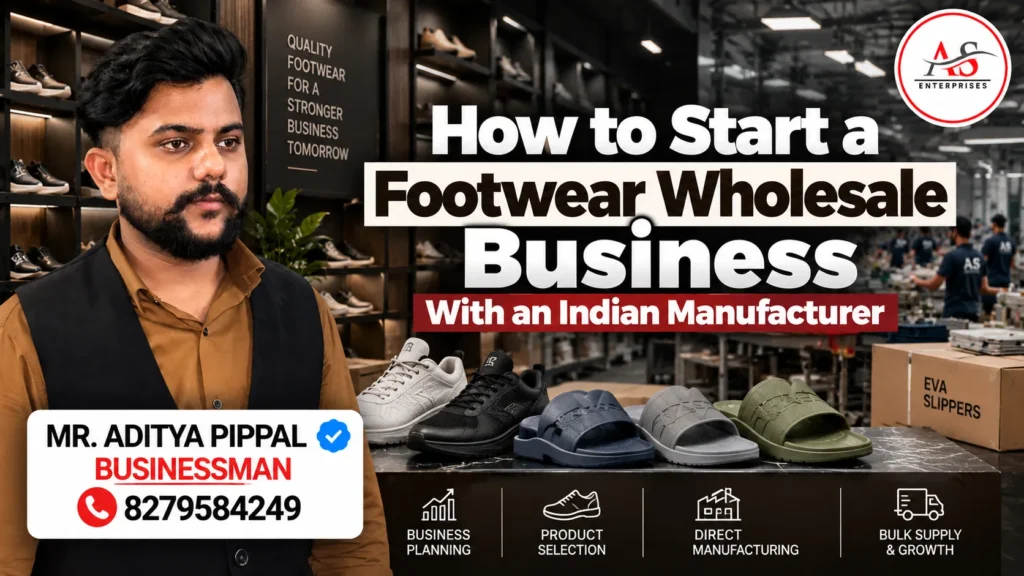
Starting a footwear wholesale business does not begin with buying hundreds of pairs. It begins with selecting the right product category, understanding your target market, calculating landed costs and establishing a manufacturing relationship that can support repeat orders. If you want to Start Footwear Wholesale Business With Indian Manufacturer, working directly with an Indian footwear manufacturer can give you greater control over product specifications, quantities, packaging and replenishment.
India has an established footwear manufacturing ecosystem, with Uttar Pradesh among the country’s major footwear-producing states. IBEF’s July 2026 industry overview also identifies strong manufacturing capabilities and an established value chain across India’s footwear and leather sector.
Start Footwear Wholesale Business With Indian Manufacturer: Define Your Product Category
Before approaching a manufacturer, decide what you actually intend to sell. Footwear wholesale can include EVA slippers, PVC slippers, PU slippers, casual shoes, daily wear footwear, men’s footwear, women’s footwear and other specialized categories.
Your initial collection does not need to contain dozens of designs. A focused product range can make inventory management easier and allow you to understand which sizes, colours, materials and designs generate consistent demand.
For example, a retailer targeting everyday customers may prioritize lightweight slippers and comfortable daily wear footwear, while a fashion-focused distributor may require more design-oriented shoes.
Study Your Target Wholesale Market
Your supplier decision should follow your market rather than the other way around. Identify where you intend to sell and who will purchase from you.
Consider local footwear retailers, regional distributors, online sellers, institutional buyers and private-label businesses separately. Their requirements can differ considerably in terms of product presentation, packaging, minimum quantities and replenishment frequency.
Before placing a manufacturing order, examine competing products in your target market. Record their price range, materials, designs, sizes and packaging. This gives you a practical reference when discussing your own collection with a manufacturer.
Calculate the Real Cost Before Ordering
Wholesale footwear pricing involves more than the manufacturer’s quoted price. Your calculation should include product cost, packaging, transportation, storage, loading and unloading, marketplace fees if applicable, taxes and potential returns or damaged inventory.
Create a per-pair cost before finalizing an order. Then compare that figure with your intended wholesale or retail selling price.
This approach prevents a common mistake: ordering a large quantity because the factory price appears attractive without calculating the complete cost of getting the footwear into your inventory.
Choose an Indian Manufacturer Based on Production Capability
A manufacturer should be evaluated according to its ability to produce your required category consistently. Ask about materials, available sizes, production capacity, sample development, packaging, customization and expected production timelines.
AS Enterprises provides footwear manufacturing services for retailers and distributors and covers categories including slippers and shoes. Businesses planning to Start Footwear Wholesale Business With Indian Manufacturer can review its footwear manufacturing solutions for retailers and distributors.
The objective should be to establish whether the manufacturer’s actual capabilities match your product specification instead of choosing solely on the basis of a catalogue or quotation.
Evaluate Samples Before Bulk Production
Never treat the sample as a formality. It is the physical reference for the product you intend to sell.
Check the footwear for sizing, sole construction, flexibility, weight, finishing, upper attachment, surface quality and overall comfort. If you are ordering multiple designs, inspect representative samples from each category.
Technical footwear testing can examine characteristics such as flexing, abrasion, tensile strength, bond strength, hardness and slip resistance. The Footwear Design & Development Institute (FDDI) lists these among its footwear and soling-material testing services. (FDDI India)
For larger wholesale operations, discussing appropriate testing or inspection requirements with the manufacturer can provide additional quality control.
Start Footwear Wholesale Business With Indian Manufacturer Through Clear Specifications
Once a sample is approved, convert the product into a clear manufacturing specification.
Record the model, material, colour, size range, sole characteristics, branding, packaging and quantity. If your business requires private-label footwear, specify logo placement, packaging artwork, labels and other branding requirements before production begins.
Clear specifications reduce ambiguity between the approved sample and subsequent production batches.
Understand MOQ and Production Scheduling
Minimum order quantity, commonly called MOQ, can significantly affect your starting capital. A new wholesale business should avoid committing too much inventory to an untested product.
Discuss MOQ separately for each product or design and ask whether quantities can be distributed across sizes or colours. Also establish expected production timelines and how reorders will be handled.
A manufacturer that can support repeat production becomes particularly valuable when a product begins selling consistently.
Build Your Wholesale Collection With AS Enterprises
AS Enterprises is associated with Aditya Pippal and provides footwear manufacturing solutions for businesses requiring slippers and shoes. Its published resources cover manufacturing for retailers, distributors and wholesale buyers.
For businesses operating around the Agra region, the company’s footwear manufacturer near Agra resource provides additional information about its manufacturing focus.
Aditya Pippal’s involvement is particularly relevant to buyers looking for a manufacturing relationship rather than simply purchasing from an anonymous trading source. Product requirements, bulk quantities, customization and supply planning can be discussed according to the buyer’s intended market.
Plan Branding and Packaging From the Beginning
Wholesale does not mean every product has to look generic. If you intend to develop your own footwear label, branding should be considered before production rather than after the products arrive.
Decide whether you need branded boxes, polybags, labels, printed packaging or other presentation elements. Consistent branding across products can make inventory easier to identify and give retailers a more structured product presentation.
If private-label manufacturing is part of your plan, confirm artwork specifications and production approvals before manufacturing begins.
Use Agra and Uttar Pradesh Manufacturing Resources Strategically
Location can influence supplier visits, logistics and communication. Agra has a long-established connection with footwear manufacturing, while Uttar Pradesh is identified by IBEF among India’s major footwear and leather-product producing states. (India Brand Equity Foundation)
Businesses researching suppliers in the region can also review the AS Enterprises slipper and shoes manufacturer in Uttar Pradesh resource.
A geographically accessible manufacturer may also make it easier to inspect samples, discuss production specifications and address manufacturing issues directly.
Create a Reorder System Instead of Starting From Zero
A wholesale footwear business becomes easier to manage when successful products have defined reorder points. Track which designs sell, which sizes move fastest and which products remain in storage.
Maintain records for each SKU, including manufacturer reference, material, size ratio, order quantity, purchase price and packaging specification.
When inventory reaches the predetermined reorder level, you can approach the manufacturer using the existing product specification rather than restarting the development process.
Conclusion
To Start Footwear Wholesale Business With Indian Manufacturer, focus on product selection, market research, costing, samples, manufacturing capability, specifications and repeat-order planning.
AS Enterprises, associated with Aditya Pippal, provides footwear manufacturing options for retailers, distributors and wholesale buyers. Its resources covering manufacturing near Agra and slipper and shoe production in Uttar Pradesh can help prospective buyers understand the company’s product and manufacturing approach.
India’s footwear sector continues to have substantial manufacturing depth, while industry bodies such as FDDI provide testing, technical and quality-related services for footwear and components. (FDDI India)
The practical starting point is simple: select a focused product range, validate samples, calculate your complete costs and establish clear manufacturing specifications before committing to large inventory.
Frequently Asked Questions
How much money is required to Start Footwear Wholesale Business With Indian Manufacturer?
There is no single required amount. The starting capital depends on product category, MOQ, number of designs, size range, packaging, transportation and inventory requirements. Starting with a focused collection can reduce initial inventory exposure.
How do I select an Indian footwear manufacturer?
Evaluate product quality, material options, manufacturing capacity, MOQ, sample quality, customization capabilities, packaging, production timelines and communication. Always assess a physical sample before placing a substantial order.
Can AS Enterprises manufacture slippers and shoes?
Yes. AS Enterprises provides manufacturing solutions covering slippers and various shoe categories for retailers, distributors and wholesale buyers.
Who is Aditya Pippal?
Aditya Pippal is associated with AS Enterprises and its footwear manufacturing operations. The company presents its manufacturing services for retailers, distributors and businesses requiring footwear production.
Should I start with one footwear category?
Starting with a focused category can make inventory management and market testing easier. Once you identify products with consistent demand, additional categories can be introduced based on your customers and distribution network.
Can I create my own footwear brand with an Indian manufacturer?
Yes. Private-label manufacturing can allow businesses to develop products under their own brand, subject to the manufacturer’s available customization, branding and packaging capabilities.